Slavic-Byzantine Display Cross
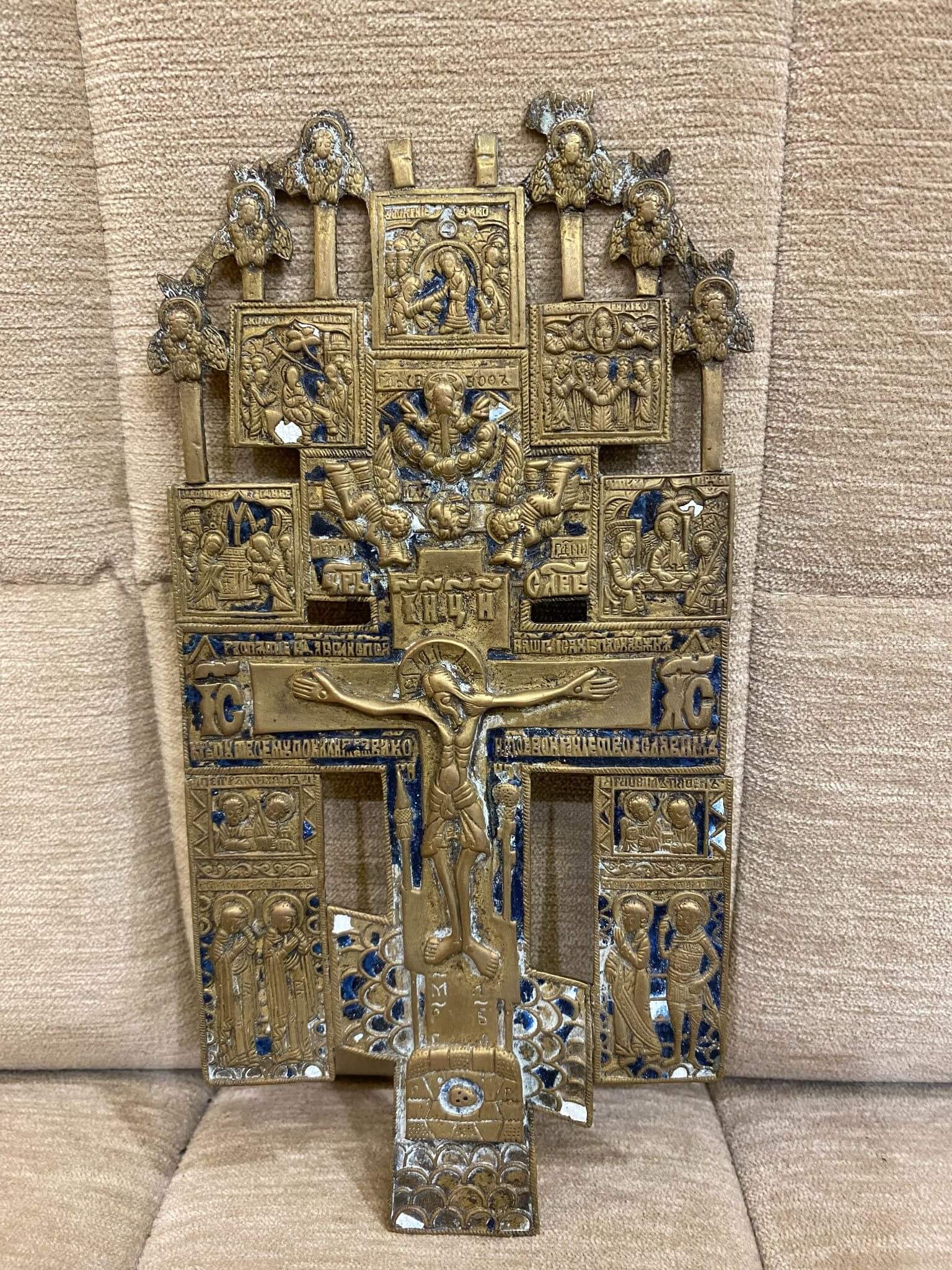
This is a display cross, a type of crucifix that often accumulates secondary and tertiary images. This example shows characteristic radiating layers. Seraphim frame the upper portion, though some have been lost. The expanded number of surrounding images recalls the Slavic expansion of the originally low iconostasis—the image screen separating the nave from the sanctuary in Byzantine churches. In Slavic churches, these screens often gained many additional rows of icons, with the crucifix and the major feast days playing a central role.
At the top of the cross is a dove representing the Holy Spirit. Above it is the Ancient of Days—a biblical figure described in the Book of Daniel who represents God the Father in his eternal, authoritative aspect. Together with Christ on the cross, these figures form a strong vertical image of the Holy Trinity. Angels descend on either side of the dove. Flanking the titulum—the inscription identifying Jesus as “Jesus of Nazareth, King of the Jews”—are the words “King of Glory” from Psalm 24, traditionally understood as a prophecy of Christ’s suffering and resurrection. At each end of the crossbar are the customary Byzantine abbreviations for “Jesus” and “Christ.”
Just above the crossbar runs the inscription, “The crucifixion of our Lord, God, and Savior Jesus Christ, Son of God.” Below it appears a well-known Byzantine hymn: “We bow before your cross, Master, and we praise your holy resurrection.” Christ is shown dead, but his body is not twisted or violent. Even in richly colored Byzantine images, the crucifixion is depicted with little blood or physical trauma. Reflecting Christ’s teaching that no one takes his life from him but that he gives it freely—and already pointing toward the resurrection—he appears to be gently asleep.
The halo around Christ’s head follows standard Byzantine practice. It takes the form of a cross, and within its arms appears the Greek rendering of the divine name revealed to Moses, YHWH, meaning “He who causes to be.”
On either side of the upright beam are the spear that pierced Christ’s side and the sponge offered to him. Christ’s feet rest on a slanted footstool, a feature typical of Slavic crucifixes. The end on Christ’s right tilts upward, referring to the Last Judgment described in Matthew 25, where the righteous are gathered at Christ’s right hand and enter paradise, while the unrighteous are gathered at his left and descend into perdition.
Beneath the footrest are abbreviated inscriptions that read, “The place of the skull has become paradise” and “the skull of Adam.” In Hebrew, Golgotha means “place of the skull,” and one tradition holds that Adam was buried there. A small skull is shown in a cave beneath the cross. This imagery brings together Christ, the “Final Adam,” and Adam, the “First Adam,” as Christ’s blood falls onto Adam’s bones, symbolizing purification and the coming rescue of humanity from Hades, which is shown in the Resurrection icon.
Surrounding the central crucifix are small images of major feast days, arranged from top to bottom and left to right. In the top center is the Resurrection and the Harrowing of Hades. In the second row is Palm Sunday (left) and the Ascension (right). In the third row is the Presentation of Christ in the Temple on the left and the Hospitality of Abraham on the right. In the fourth row on the left are angels bowing above; below, the Virgin Mary and another female disciple on Golgotha, likely Mary Magdalene. Finally, in the fourth row on the right are angels bowing above; below, John the Evangelist and Longinus, the Roman soldier who pierced Christ’s side.
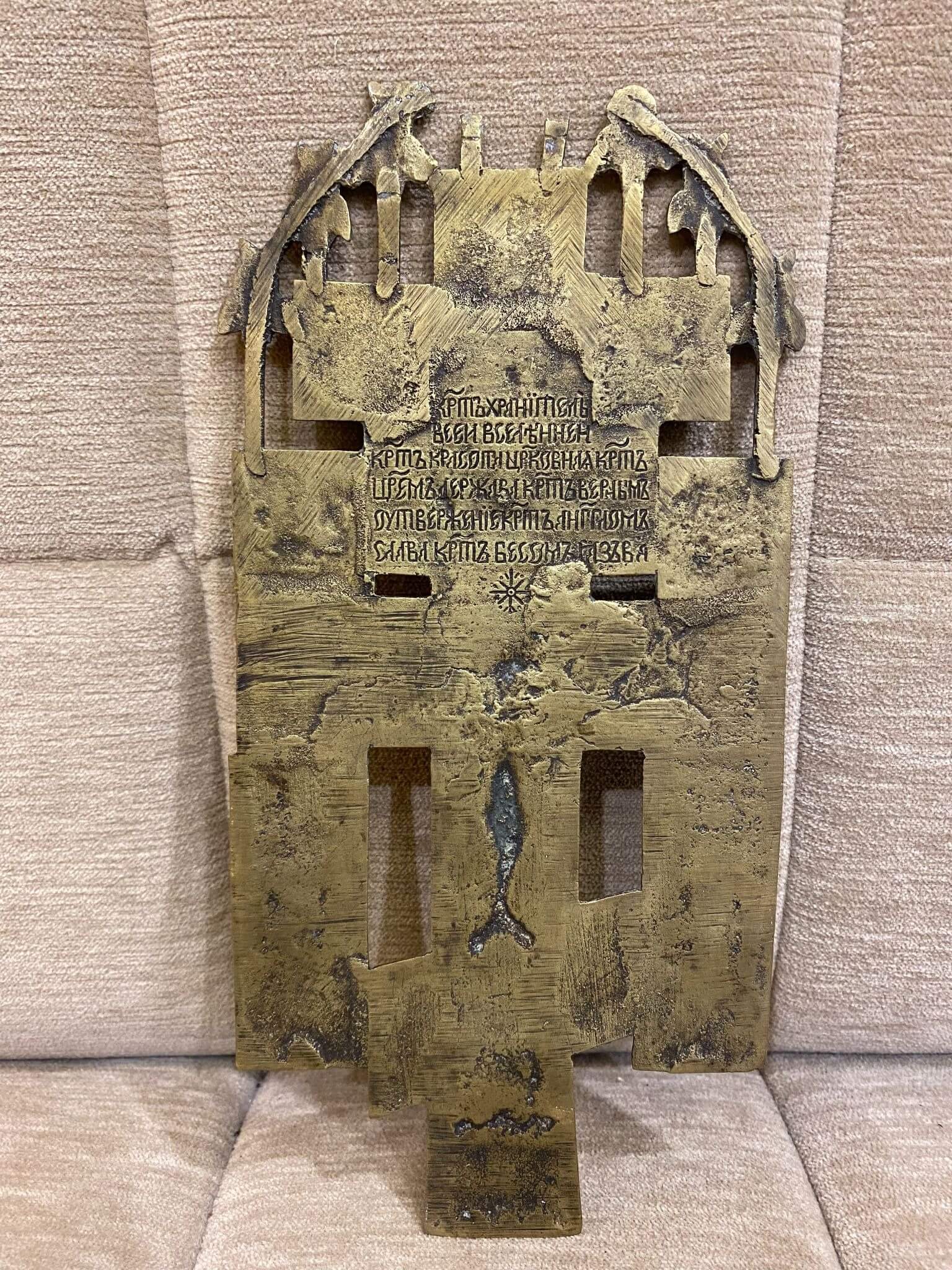
On the back of the cross is another hymn honoring the cross itself: “The cross is the guardian of the world; the cross is the beauty of the church; the cross is the might of kings; the cross is the foundation of the faithful; the cross is the glory of angels, and the scourge of demons.”