Slavic Blessing Cross
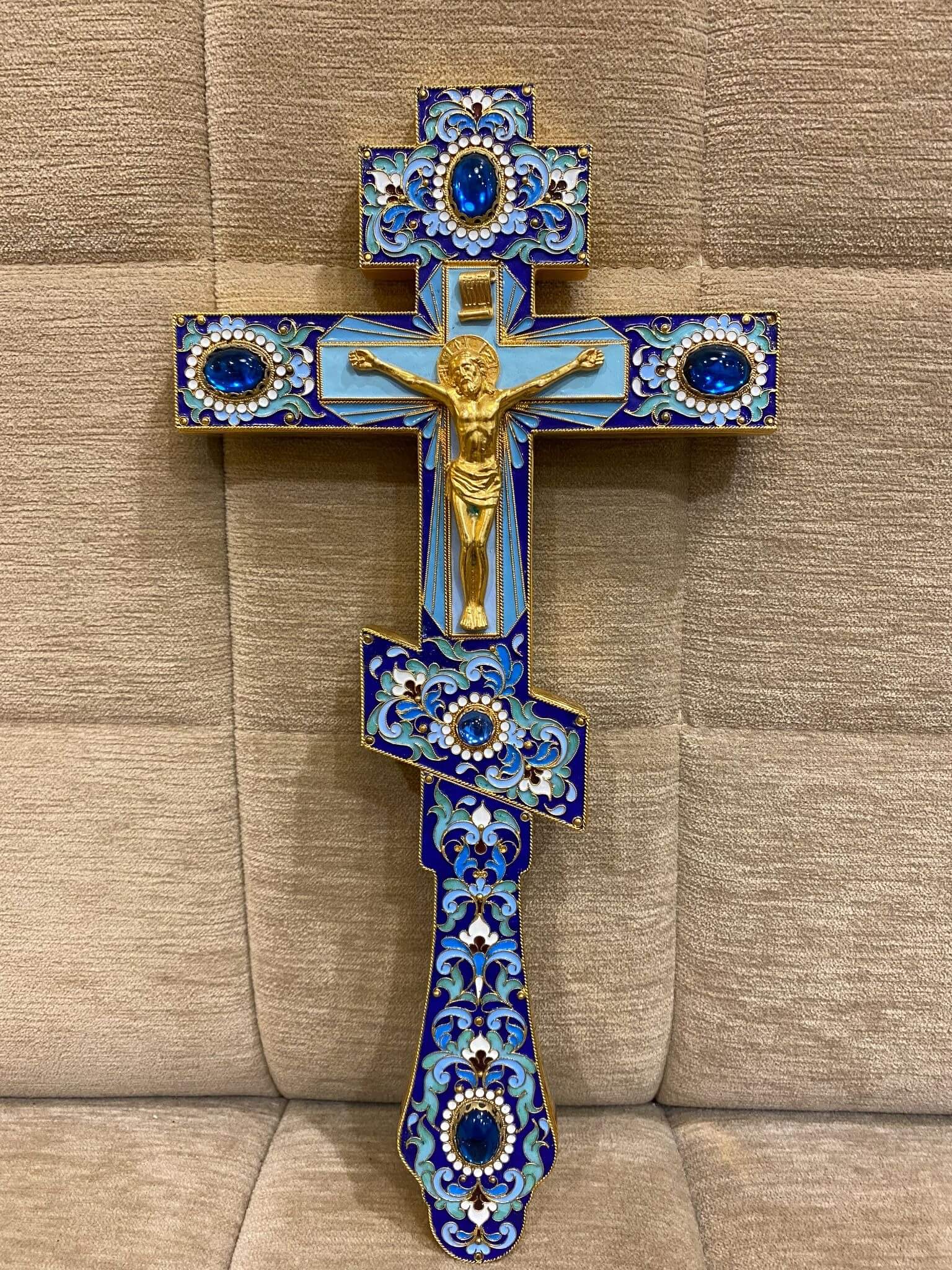
This Eastern Christian blessing hand cross was designed to be held by a priest during liturgical blessings and presented to the faithful for veneration after certain services. The lower portion of the cross ends in a teardrop-shaped handle, allowing it to be comfortably grasped and raised. Such crosses were functional devotional objects rather than fixed altarpieces, intended to be handled and viewed at close range.
The form of the cross reflects the Orthodox, especially Slavic, tradition. A second horizontal bar identifies this lineage and is typically shown at a slant. This tilt has been interpreted in two complementary ways: as representing Christ’s movement in the moment of death, and symbolically as pointing upward on Christ’s right toward the repentant thief who entered paradise, and downward on the left toward the unrepentant thief. The overall outline of the cross, which is less fluid than typical Greek examples, further suggests a Slavic context.
The titulum at the top of the cross is written in Cyrillic and corresponds to the familiar INRI inscription identifying Jesus as “Jesus of Nazareth, King of the Jews.” Instead of the Latin Rex (“King”), it uses the Slavic equivalent, often rendered as Csar.
Eastern Christian blessing crosses frequently present the Crucifixion on one side and the Resurrection on the other, expressing Orthodox theology’s understanding of these events as inseparable aspects of a single act of salvation. In some symbolic depictions, Christ appears not as the suffering victim but as the triumphant Lord (Christus triumphans), clothed rather than stripped, with arms raised as though rising from the cross. He may be shown with rays of light or an aureole and depicted simultaneously as prophet, king, and great high priest. This theological framework underlies the imagery of blessing crosses such as this one, in which death and victory are held together rather than opposed. The Crucifix Initiative has another Slavic blessing cross that displays the resurrected Christ.